How to Optimize Content for Google AI Overviews
Google Search is evolving beyond traditional blue links, with AI-powered search experiences helping users explore topics, compare options, and find answers more quickly. For businesses, this creates an opportunity to improve online visibility by publishing useful, accurate, and trustworthy content that meets users’ needs.
Optimizing content for Google AI Overviews means making your website’s information easy to discover, understand, verify, and use while maintaining strong traditional SEO fundamentals. There is no guaranteed formula for appearing in an AI Overview, and Google does not require a separate set of AI-specific ranking techniques. However, helpful content, a technically accessible website, clear information architecture, and demonstrated expertise remain important.
In this guide, we will explore how to optimize website content for Google AI Overviews, improve visibility across AI-powered search experiences, and apply Answer Engine Optimization (AEO) and Generative Engine Optimization (GEO) principles to your digital marketing strategy.
What Are Google AI Overviews?
Google AI Overviews are AI-generated summaries displayed within eligible Google Search results. They help users understand complex topics, discover relevant information, and explore supporting web pages.
Instead of requiring users to visit several websites to understand a subject, an AI Overview can summarize key points and provide links to relevant sources for further reading. These summaries may appear for informational, educational, research-oriented, and other queries when Google’s systems determine that an AI-generated response would be useful.
For example, when someone searches for “How can a small business improve local SEO?”, an AI Overview may summarize relevant approaches, such as optimizing a Google Business Profile, improving location pages, earning legitimate reviews, and maintaining consistent business information.
For businesses and marketers, appearing as a supporting source can create an additional opportunity to reach potential customers. However, inclusion is not guaranteed, even when a website follows SEO best practices.
Why Is Google AI Overviews Optimization Important?
Search behavior is changing as users increasingly ask detailed questions and expect relevant answers rather than simply browsing a list of web pages.
Optimizing content for AI-powered search experiences can help businesses improve their discoverability, demonstrate their expertise, and connect with people researching products, services, and solutions.
1. Improve Organic Search Discoverability
AI Overviews can include links to supporting pages. Creating relevant, well-organized content gives your website an opportunity to be considered as a useful source for appropriate search queries.
2. Reach Users Earlier in Their Buying Journey
People often use conversational questions when researching a purchase or service. A business that explains the problem, compares possible solutions, and provides practical recommendations can connect with users before they are ready to make a decision.
3. Build Brand Awareness and Credibility
When users encounter your brand in relevant search experiences, they may become more familiar with your expertise. Credibility is strengthened when your content is accurate, specific, transparent, and supported by genuine experience.
4. Support AEO and GEO Strategies
Answer Engine Optimization focuses on making content useful and accessible for systems that provide direct answers. Generative Engine Optimization focuses more broadly on improving the discoverability and usefulness of information in generative AI experiences.
Both approaches benefit from strong SEO fundamentals, original insights, and content that directly addresses users’ needs.
5. Create More Meaningful Content
The process of optimizing for AI-powered search encourages businesses to address related questions, explain complex subjects clearly, and provide information that goes beyond generic marketing copy.
The objective should not be to produce content solely for AI systems. It should be to create the most useful resource for your intended audience.
Stay Ahead of Google’s Updates
How Do Google AI Overviews Work?
Google’s AI search experiences use information from its Search systems and AI technologies to generate responses and surface supporting links. The systems may explore related queries to understand different aspects of a user’s question and retrieve relevant information.
For example, someone searching for “best digital marketing strategy for a startup” may also need information about SEO, paid advertising, social media, content marketing, budget allocation, and performance measurement.
A comprehensive resource that answers these related questions meaningfully may be useful for several connected searches.
However, Google does not disclose a fixed formula that guarantees selection for AI Overviews. A page must be indexed and eligible to appear in Google Search, but indexing alone does not guarantee that it will be selected as a supporting source.
The most reliable approach is to make your content accessible to Google, satisfy the user’s search intent, demonstrate expertise, and provide useful information that adds value beyond what is already available.
How to Optimize Content for Google AI Overviews
1. Understand Search Intent and User Questions
The first step in optimizing content for Google AI Overviews is understanding what users actually want to know.
Search intent refers to the purpose behind a query. A person searching for a definition has different expectations from someone comparing services or looking for a specific product.
The four common categories of search intent are:
Informational intent: Users want to learn something or find an answer.
Navigational intent: Users want to reach a particular website or brand.
Commercial investigation: Users compare options before making a decision.
Transactional intent: Users are ready to purchase, book, or take another action.
To identify search intent, research your target keywords, review relevant search results, examine customer questions, and study discussions in your industry.
For a topic such as “Google AI Overviews optimization,” useful related questions might include:
- What are Google AI Overviews?
- How does Google select sources for AI Overviews?
- How can a website improve its chances of appearing in AI Overviews?
- Does traditional SEO still matter for AI search?
- What is the difference between AEO and GEO?
Organize these questions into meaningful sections rather than publishing repetitive pages for every keyword variation.
Pro tip: Use Google Search Console to identify queries already generating impressions for your website. These queries can reveal content gaps, relevant subtopics, and opportunities to improve existing pages.
2. Provide Direct Answers at the Beginning
One practical way to improve content clarity is to answer the main question near the beginning of the relevant section.
Readers should not need to navigate several paragraphs of introductory text before discovering the information they need.
For example, consider this question:
What is Google AI Overviews optimization?
Google AI Overviews optimization is the process of improving content quality, relevance, accessibility, and technical SEO so that a web page can be considered as a supporting source in Google’s AI-generated search summaries.
The answer defines the concept immediately before expanding on its practical implications.
Use this approach throughout your article:
- Answer the question directly.
- Explain why the answer matters.
- Provide supporting details or examples.
- Add steps, evidence, or recommendations where appropriate.
Direct answers can make your content easier for readers to navigate and understand. However, a short answer alone does not guarantee AI Overview visibility; it must be supported by useful, accurate information.
3. Build a Clear Content Structure
A well-structured article helps readers understand the relationship between the main topic and its supporting details.
Use a logical heading hierarchy, with one descriptive H1 for the page’s primary topic, H2 headings for major sections, and H3 headings for related subsections.
For example:
- H1: How to Optimize Content for Google AI Overviews
- H2: Understanding Google AI Overviews
- H2: Content Optimization Strategies
- H3: Answering User Questions
- H3: Improving Topical Coverage
- H3: Demonstrating Expertise
- H2: Measuring AI Search Visibility
Keep paragraphs focused and use numbered lists for processes, bullet points for related items, and tables when comparing concepts.
A table can help users quickly understand the difference between traditional SEO, AEO, and GEO. A checklist can help them implement a strategy without rereading the entire article.
Do not force every paragraph into a separate heading. The goal is a natural, readable structure rather than an artificially fragmented page.
4. Create Helpful, Original, and In-Depth Content
Content quality is one of the most important foundations of a sustainable SEO strategy.
Simply rewriting competing articles or producing generic explanations is unlikely to distinguish your website. Instead, develop content that answers the user’s question thoroughly and includes useful information that competing pages may not provide.
Consider incorporating:
- Original research or survey findings.
- Expert commentary and practical experience.
- Real-world examples and case studies.
- Step-by-step instructions.
- Original comparisons and decision-making frameworks.
- Relevant data with reliable sources.
- Lessons learned from actual projects.
For instance, a digital marketing agency writing about AI search optimization could explain how it audits a client’s content, identifies missing answers, improves internal linking, and measures changes in organic search visibility.
Only publish results and case studies that you can substantiate. Never invent performance statistics or imply that a particular optimization guaranteed inclusion in an AI Overview.
Google’s people-first content guidance emphasizes originality, usefulness, accuracy, and demonstrable expertise rather than content created primarily to manipulate search rankings.
5. Demonstrate Experience, Expertise, Authoritativeness, and Trust
Trust matters when users need reliable information to make decisions. Your content should make it clear who created it, why readers should trust it, and what evidence supports its recommendations.
The E-E-A-T framework refers to Experience, Expertise, Authoritativeness, and Trust. It is a useful quality framework, not a standalone score that guarantees rankings.
To strengthen these signals:
Add clear author biographies that accurately describe relevant experience.
Include an editorial or expert review process where appropriate.
Cite authoritative sources for factual claims.
Publish genuine case studies and original insights.
Maintain an informative About Us page.
Provide clear contact information and business details.
Disclose relevant commercial relationships when necessary.
Correct outdated information and unsupported claims.
For example, an article about technical SEO should ideally be written or reviewed by someone with relevant knowledge. Practical examples from real audits can make the advice more useful than a generic explanation.
Avoid fabricated author credentials, fake testimonials, and unsupported claims about expertise.
6. Use Relevant Entities and Semantic SEO
Semantic SEO involves making the meaning and relationships within your content clear.
An entity is a clearly identifiable person, organization, product, place, concept, or other subject. Relevant entities help establish the context of a topic.
For a blog about Google AI Overviews, relevant concepts may include:
- Google Search
- Google Search Console
- Organic search visibility
- Search intent
- Technical SEO
- Structured data
- Answer Engine Optimization
- Generative Engine Optimization
- E-E-A-T
- Internal linking
- Content quality
Include these concepts when they help explain the subject. Do not add unrelated terms simply to make the article appear more comprehensive.
You should also explain relationships between concepts. For example, describe how technical SEO supports crawling and indexing, how content quality helps meet user needs, and how Search Console provides insights into search performance.
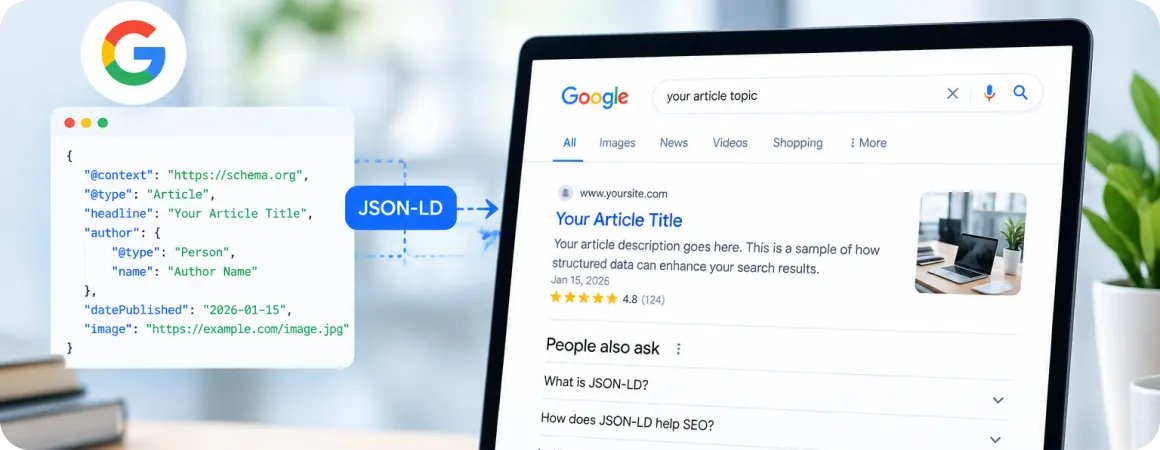
7. Add Structured Data Where Appropriate
Structured data is standardized markup that helps search engines interpret information on a web page.
Depending on the content, relevant schema types may include:
- Article: Describes an article and its associated details.
- Organization: Provides information about a business or organization.
- BreadcrumbList: Represents a page’s position within a website hierarchy.
- Person: Describes an author or another relevant individual.
Implement schema only when it accurately reflects the visible page content and follows the relevant search feature guidelines.
Validate the markup and check for errors using appropriate testing tools.
It is important to understand that special AI Overview schema is not required. Structured data does not guarantee inclusion in AI Overviews, and adding FAQ markup does not guarantee that Google will display an FAQ rich result.
Use structured data as part of your broader technical SEO strategy rather than treating it as an AI ranking shortcut.
8. Strengthen Internal Linking
Internal links connect relevant pages within your website. They help users discover additional information and help search engines understand the relationships between your pages.
For example, an article about Google AI Overviews could link naturally to supporting resources about:
- Keyword research and search intent.
- Technical SEO audits.
- Content marketing strategy.
- Schema markup implementation.
- Google Search Console reporting.
- AEO and GEO services.
Use descriptive anchor text that explains what readers will find on the destination page.
Avoid excessive exact-match anchor text or linking to irrelevant pages.
A useful internal linking strategy also works in reverse: supporting articles should link back to the main guide when it helps users understand the broader topic.
This creates a connected content ecosystem rather than a collection of isolated blog posts.
9. Optimize Images and Videos
Relevant visuals can make complex information easier to understand and improve the overall usefulness of a page.
Consider adding:
- Original process diagrams.
- Screenshots that demonstrate real workflows.
- Comparison charts.
- Short instructional videos.
- Examples of content structures.
- Annotated illustrations explaining technical concepts.
Use descriptive image filenames and meaningful alternative text when appropriate. Ensure that important information is also available in accessible text rather than being communicated only through an image.
For videos, provide a descriptive title, a useful explanation, and captions or a transcript where appropriate.
10. Maintain Content Accuracy and Freshness
Outdated content can mislead users, particularly in rapidly changing areas such as AI search, digital marketing, and technology.
Review important pages periodically to verify that their facts, links, examples, and recommendations remain accurate.
During a content review:
- Check whether the main advice is still valid.
- Verify statistics and citations against their original sources.
- Replace broken links.
- Update outdated screenshots or instructions.
- Add meaningful developments that improve the article.
- Remove redundant or unsupported information.
Do not change publication dates merely to make an article appear fresh. Update a page when substantive improvements are made and display dates honestly.
For this topic, Google’s official documentation is especially valuable because its guidance can evolve as AI-powered search features develop.
11. Improve Technical SEO and Indexability
Even high-quality content cannot perform as intended if search engines cannot access or index the page appropriately.
Review the technical elements that determine whether your content is discoverable.
Check crawling and indexing
- Ensure the page is not unintentionally blocked by robots.txt.
- Review any noindex directives.
- Confirm that the canonical URL is correct.
- Check the page’s indexing status in Google Search Console.
- Ensure important pages can be discovered through internal links.
Improve page experience
- Make the website responsive on mobile devices.
- Reduce unnecessary page-loading delays.
- Compress and properly size images.
- Avoid intrusive elements that obstruct the main content.
- Ensure that important content is available in crawlable text.
Review JavaScript rendering
If the site relies on JavaScript, check that important content and links are available to Google after rendering. Avoid accidentally hiding essential information behind interactions that prevent users or crawlers from accessing it.
Maintain a clear site architecture
Organize related content into sensible categories, keep URLs understandable, and ensure that important pages are not buried too deeply within the site.
These actions support both conventional organic search and eligibility for Google’s AI search features. They do not guarantee that a page will be selected for a particular AI-generated response.
How Do SEO, AEO, and GEO Work Together?
Traditional SEO helps search engines discover and understand your website. AEO encourages you to answer specific user questions clearly. GEO emphasizes useful, distinctive content that can be understood and considered in generative AI experiences.
For example, a digital marketing agency publishing a guide to local SEO could use traditional SEO to optimize the page, AEO to answer questions about Google Business Profile optimization, and GEO principles to include original case studies and practical recommendations.
These approaches should form one integrated content strategy rather than three disconnected marketing campaigns.
Google’s official guidance also emphasizes that optimizing for its generative search features largely means applying established SEO best practices and producing valuable, original content—not relying on separate AI-specific hacks.
Common Mistakes to Avoid When Optimizing for Google AI Overviews
Even a technically sound website can struggle to stand out if its content provides little value or fails to meet the user’s needs.
1. Publishing Generic AI-Generated Content
Using AI tools for research, outlining, or editing can be helpful. However, publishing large volumes of unreviewed, repetitive content without adding value can undermine content quality.
Solution: Review every article for accuracy, originality, practical usefulness, and relevance to your audience. Add expert input and genuine examples.
2. Keyword Stuffing
Repeating phrases such as “Google AI Overviews optimization” unnaturally does not create a better user experience.
Solution: Use your primary keyword naturally and include related terms only when they fit the subject.
3. Ignoring Search Intent
An article may contain many keywords but still fail to answer the question that brought the reader to the page.
Solution: Identify the reader’s main problem and address it early. Support the answer with relevant details and actionable advice.
4. Assuming FAQ Schema Guarantees AI Visibility
Adding FAQ sections or schema markup does not guarantee AI Overview inclusion or special search-result placement.
Solution: Write FAQs because they help users find useful answers. Implement structured data only when appropriate and in accordance with Google’s guidelines.
5. Creating Multiple Pages for Similar Keywords
Publishing separate articles for every minor keyword variation can lead to repetitive content and unnecessary competition between your own pages.
Solution: Consolidate closely related questions into comprehensive resources when doing so provides a better experience.
6. Ignoring Technical SEO
Content may be valuable but remain inaccessible because of indexing directives, crawling restrictions, broken links, or rendering issues.
Solution: Audit crawling, indexing, canonicalization, internal links, and mobile usability regularly.
7. Expecting Guaranteed Results
No SEO agency, tool, or content format can guarantee that Google will select a page for an AI Overview.
Solution: Focus on sustainable improvements in content quality, organic visibility, technical accessibility, and user satisfaction.
How to Measure AI Search Visibility
Optimizing content is only one part of the process. You should also evaluate whether your efforts are improving discoverability and attracting relevant visitors.
1. Monitor Google Search Console
Track impressions, clicks, click-through rates, average positions, and relevant queries for your target pages.
Compare performance over time and investigate which queries generate visibility but few clicks. These may indicate opportunities to improve titles, introductions, content relevance, or the value proposition.
Google’s Search Console reporting and documentation continue to evolve. Use the available reports to understand your site’s performance and follow official guidance when interpreting AI-related visibility. Do not assume that all AI Overview appearances or citations are separately reported in standard performance data.
2. Analyze Organic Traffic in Google Analytics 4
Use GA4 to understand how organic search visitors interact with your website.
Useful metrics include:
- Organic landing-page sessions.
- Engagement rate.
- Key events and conversions.
- Lead submissions.
- Contact enquiries.
- Purchases or other business outcomes.
A rise in traffic is valuable, but qualified leads and meaningful conversions provide a stronger indication of commercial impact.
3. Track Relevant Search Queries
Build a list of important informational, commercial, and conversational queries related to your business.
Review how your pages perform for these queries over time. You can also manually inspect relevant AI search experiences, recording the date, query, location, device, and whether your brand or page appears.
Because AI-generated responses can vary, treat manual checks as directional observations rather than a complete measurement of visibility.
4. Evaluate Brand Mentions and Referral Traffic
Monitor referral traffic from AI-related platforms where analytics data identifies it, along with brand mentions and relevant inbound enquiries.
Not every AI-assisted visit will be clearly attributable to a particular source. Avoid assuming that an increase in branded searches or direct traffic was caused exclusively by AI Overviews.
5. Measure Business Outcomes
Ultimately, the purpose of SEO, AEO, and GEO is to help the right people discover your business and take meaningful actions.
Measure whether your content contributes to qualified enquiries, sales, newsletter registrations, demo requests, or other relevant goals.
A practical reporting dashboard should combine search performance, landing-page engagement, lead quality, and conversion data rather than relying on a single visibility metric.
Google AI Overviews Optimization Checklist
Use this checklist when publishing a new blog or improving an existing page.
- Identify the primary keyword and user search intent.
- Research relevant questions and related subtopics.
- Write a descriptive title and a clear H1 heading.
- Answer the main question near the beginning.
- Organize content using logical H2 and H3 headings.
- Add original insights, examples, or expert commentary.
- Verify facts and cite trustworthy sources.
- Include relevant internal and external links.
- Optimize images, alternative text, and relevant video content.
- Implement appropriate structured data where useful.
- Check crawlability, indexability, canonical tags, and mobile usability.
- Review the page for duplication, unnecessary repetition, and keyword stuffing.
- Monitor relevant queries and landing-page performance.
- Update the content when meaningful new information becomes available.
Improve Your AI Search Visibility with BrandWora
Google AI Overviews are changing how users discover information, but successful optimization still starts with a strong SEO foundation. Businesses should focus on creating original, accurate, well-structured content that answers real questions, demonstrates expertise, and provides a positive user experience.
By combining traditional SEO with AEO and GEO principles, you can build a content strategy designed to serve users across conventional search results and emerging AI-powered search experiences. Consistent technical maintenance, meaningful internal linking, trustworthy information, and ongoing performance measurement can further strengthen your website’s discoverability.
BrandWora can help your business build a stronger digital presence through strategic SEO, content optimization, AEO, and GEO services. Whether you want to improve organic search visibility, create content that answers customer questions, or strengthen your brand’s discoverability across AI-powered search experiences, BrandWora can help you develop a strategy aligned with your business goals.
Start by evaluating your existing content, identifying opportunities to provide greater value, and building a sustainable optimization plan that supports long-term growth.